
Healthcare Provider Firmographic Data: Fields, Vendors, Uses
Standard B2B firmographic data does not translate to healthcare practices. SIC codes are too broad, employee counts are misleading, and revenue data barely exists. Here is what works.
Updated September 2026
Our data
The examples below calculate employee-versus-provider counts, a 120-account filter funnel, and unique providers across two locations. They use fictional inputs and expose the counting rules; they are not market estimates. These examples were prepared with AI assistance.
What Firmographics Means in Healthcare
In standard B2B sales, firmographics describe a company's characteristics: industry, employee count, revenue, location, founding year, and technology stack. These attributes let sales and marketing teams segment accounts, define ICPs, score leads, and prioritize territories. The concept translates to healthcare; however, the specific attributes and data sources are materially different because healthcare practices are not structured like typical businesses.
A medical practice's firmographic profile includes attributes specific to healthcare delivery. Practice size measured by provider count (not employee count), specialty mix by industry-standard Healthcare Provider specialty classifications, ownership structure (solo, group, DSO, health system-affiliated), number of locations, years in operation, patient volume indicators, payer mix, technology stack (EHR, practice management, billing platform), and geographic characteristics of the practice area. These fields describe the practice as a business entity in ways that standard firmographic databases do not capture.
Healthcare firmographics are harder to compile than standard B2B firmographics because medical practices do not report data the way public companies or even typical SMBs do. Most practices are private entities that do not file public financial reports. These are not covered by standard business intelligence databases with the same depth as technology companies or manufacturers. Building a reliable firmographic dataset for healthcare practices requires combining public provider data from the CMS NPI Registry, business registrations, web intelligence, and proprietary research.
The fragmented nature of healthcare delivery also complicates firmographic data. A single physician might practice at three different locations, be credentialed with four insurance panels, hold privileges at two hospitals, and be employed by one entity while billing under another. Capturing this complexity at the practice level requires careful aggregation logic that most standard business databases are not designed to handle. Healthcare firmographics is a specialized discipline rather than a simple extension of general B2B data practices.
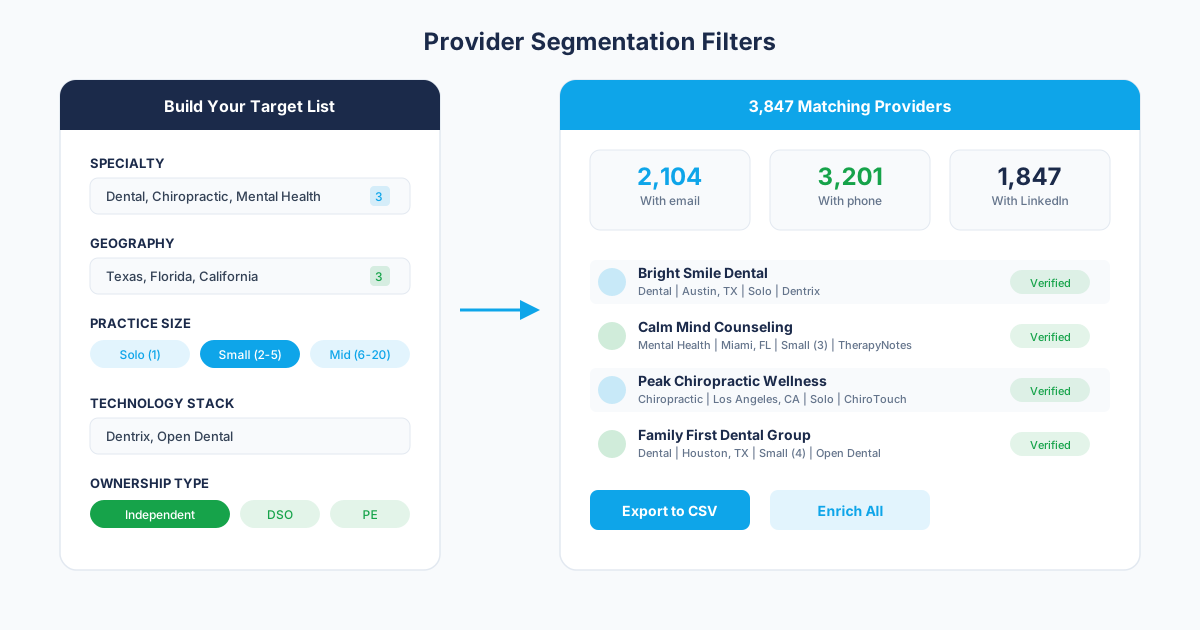
Why Standard Firmographic Data Does Not Work for Healthcare Practices
Compare employee and provider counts on the same unit
Consider two fictional practices. Practice A has 5 physicians and 20 other staff, for 25 employees. Practice B has 3 physicians and 37 other staff, for 40 employees. Ranking by total employees puts B first; ranking by physicians puts A first. Neither count alone establishes revenue or purchasing authority. Choose the measure that matches your product, define which roles are counted, and preserve both when available.
An industry code can help form an initial pool, but it does not replace specialty or organization research. Keep the source classification as one field, then add the service, specialty, and size criteria needed for the campaign. Avoid treating every record in a broad industry category as an equivalent account.
Revenue data is largely unavailable for private medical practices. Unlike publicly traded companies or even mid-market businesses that appear in commercial credit databases, most physician practices are private entities that do not disclose revenue. Estimates based on national averages by specialty and provider count are the best available proxy; however, these are estimates rather than actuals. A practice's revenue is influenced by payer mix, procedure volume, geographic market, and operational efficiency in ways that make estimates unreliable for individual account scoring.
Technology data from standard firmographic providers misses healthcare-specific systems. General B2B technology detection tools identify web technologies, marketing tools, and business software. They typically miss the most important technology decisions in a medical practice: which EHR system is installed, which practice management platform is used, which billing or RCM vendor handles claims, and whether the practice uses telehealth. These are the technology fields that matter for healthcare B2B targeting, and they require healthcare-specific detection methods.
The result is that standard firmographic databases, the ones that work well for targeting SaaS companies, manufacturers, or financial services firms, produce incomplete and misleading profiles when applied to healthcare practices. You need a healthcare-specific firmographic approach that uses the right attributes, the right data sources, and the right aggregation logic.
Even within healthcare, firmographic data requirements vary by segment. Dental practices, behavioral health clinics, surgical centers, and physician practices have different organizational structures and relevant attributes. A firmographic field that matters for dental (number of operatories, DSO affiliation) may be irrelevant for cardiology (cath lab capacity, hospital affiliations). Define the firmographic fields that are relevant to your specific ICP before evaluating data sources, and recognize that no single firmographic database covers healthcare segment equally well.
Healthcare-Specific Firmographic Fields That Matter
Provider count. Define whether the measure is unique people across the practice, people listed at a location, or a narrower role group. Link each counted person to current practice evidence and preserve the source date. An address match is a candidate relationship to review, especially in a shared building.
Specialty mix. Keep the provider’s taxonomy and the practice’s advertised service categories separate. Aggregate supported provider relationships to show the practice mix, and allow more than one specialty. Avoid inferring that a practice offers a procedure solely because one associated clinician has a broad taxonomy.
Location count. Give each operating site an identifier and connect it to a practice only where the relationship is supported. Distinguish the number of addresses from the number of unique groups. A shared brand can prompt further research, but central purchasing should remain a qualification question.
Practice ownership type segments the market by decision-making structure. Independent solo practices, independent group practices, practices owned by dental service organizations (DSOs) or management service organizations (MSOs), practices affiliated with health systems, and practices owned by private equity are distinct segments with different buying processes, budget authority levels, and vendor evaluation criteria. Ownership type is one of the highest-value firmographic fields for healthcare targeting and one of the hardest to determine at scale.
Technology stack detection identifies the EHR, practice management, billing, and other clinical systems in use. This is the healthcare equivalent of technographic data in general B2B. Knowing that a practice runs Epic vs. EClinicalWorks vs. Athenahealth determines whether your product integrates, whether the practice is likely to switch systems, and which competitive displacement messaging to use. Technology detection for healthcare practices uses web scraping, job posting analysis, patent filings, and vendor relationship databases rather than the JavaScript-based detection used for SaaS companies.
Firmographic Field Reference: What Each Field Tells You
The table below documents the key firmographic fields for healthcare practice targeting, their source methodology, and how each field applies to sales and marketing workflows. Use this guide to define the fields and acceptance rules; when you need a scoped dataset built for a campaign, see our practice firmographics service.
| Field Name | What It Tells You | Source Methodology | Sales Application |
|---|---|---|---|
| Provider Count | Unique providers in the defined role set; credentials require separate verification | Dated practice roster and verified person-to-practice links | Segment by practice size tier; predict deal size and cycle length |
| Revenue Range | Modeled revenue band with assumptions, or reported revenue with a dated source | Specialty benchmarks x provider count x geo adjustment | Prioritize high-value targets; size proposals appropriately |
| Ownership Type | Decision-making structure (solo, group, DSO, PE-backed, health system) | State filings, PE deal databases, web research, parent entity mapping | Route to correct sales motion; adjust messaging for buyer type |
| Years in Operation | Supported opening date, distinct from registry enumeration | Dated practice history or opening announcement; keep enumeration and filing dates separate | Target new practices (active buyers) vs. Established (displacement plays) |
| Specialty Mix | Clinical focus of the practice (single vs. Multi-specialty) | specialty classifications aggregated to practice level | Match product relevance to clinical workflows |
| Location Count | Single vs. Multi-site operation; geographic footprint | NPI address matching + organizational NPI linkage | Identify site coverage and investigate the purchasing structure |
| Technology Stack | Installed EHR, PM, billing, and telehealth systems | Web scraping, job postings, vendor directories, ONC data | Competitive displacement; integration-based selling |
| Payer Mix Indicators | Estimated commercial vs. Medicare vs. Medicaid patient share | Practice-specific source with payer definitions, period, and denominator; otherwise unknown | Use only a defined source and denominator; do not infer budget from area demographics |
Keep stable practice and location identifiers alongside provider identifiers. Set a review trigger for each field and retain its observation date. A changed team page can trigger provider-count review; a new portal or acquisition announcement can trigger technology or relationship review. A scheduled refresh alone does not establish that every field is current.
Use Cases for Healthcare Firmographic Data
Account selection and market sizing
Turn the ideal customer profile into explicit filters before counting the market. For a fictional software campaign, use a defined region, 5–20 currently associated providers, a supported specialty mix, and evidence of a compatible workflow. Keep ownership and installed-system requirements unresolved until their sources support them. A record that misses evidence is an unknown, not automatically a poor-fit practice.
In an illustrative funnel, 120 candidate practices include 90 in the selected geography; 36 of those meet the provider-count range; 24 of those have the requested specialty evidence. The evidence-qualified count is 24, or 24 / 120 = 20% of the starting pool. If 8 of those 24 lack technology evidence, only 16 have all four fields resolved. Report the 8 separately so “unknown” does not disappear into “does not use the system.”
Territory design and sales preparation
Balance territories with a measure tied to the offer. Fifty practices with 10 relevant providers each and 250 practices with 2 each both total 500 providers, but they require different numbers of account conversations. Inspect travel, location count, group relationships, and existing customer exclusions before treating the territories as equivalent.
For a device campaign, the relevant specialty and advertised procedure may matter more than total headcount. For a software campaign, confirmed integration requirements may decide fit. Send the rep a compact account record with the field evidence and a short list of unresolved questions. A technology signal should produce a discovery question rather than a claim that the practice intends to replace its current system.
Acquisition research and competitor coverage
Use practice records to organize a research queue: locations, supported group links, service mix, and available operating information. Keep reported ownership, brand association, and management relationships separate. A directory or modeled revenue figure is not a substitute for transaction diligence or financial statements.
For competitive research, count only accounts with evidence supporting the named product and preserve the date and detection method. Report “no evidence found” separately from a confirmed different vendor. Compare the same specialty and size segments before describing a difference in coverage; a portal-only scan and a verified customer list have different limitations.
For cross-specialty firmographic research, review the scope and field definitions in our practice firmographics service before choosing a dataset.
Building a Firmographic Dataset for Healthcare
Resolve people, locations, and practices before aggregating
- Normalize names and addresses while preserving their original values. Keep suite numbers so distinct practices in the same building remain distinguishable.
- Generate candidate links using identifiers, domains, names, and addresses. Do not accept a link from a shared address alone.
- Check each relationship against a current practice roster or another source explicitly connecting the person and practice. Record conflicting and unavailable evidence.
- Create separate practice, location, and provider IDs. Store the relationship type and source date rather than overwriting a person’s identity with one employer.
- Count distinct provider IDs within the agreed scope. Reconcile the total with the accepted relationship table and review unexpected changes.
Worked example: one fictional group lists clinicians A, B, and C at its north office, and B, C, and D at its south office. That is 6 location-provider relationships, 4 unique providers, and 2 locations. A territory file may need all 6 relationships; an account-size field should say 4 unique providers. Neither number proves common legal ownership or shared budget authority.
Keep the refresh path reversible. Store the previous value, replacement value, dated source, and reason for the change. When a provider disappears from one roster, review the relationship before deleting the provider from the entire dataset. When two practices merge, retain the old account IDs as historical references and confirm the new operating structure before rerouting leads.
Start with NPPES as one provider-identity reference, then establish current practice relationships separately. CMS publishes monthly replacement files and weekly incremental updates, and cautions that enumeration does not validate licensing or credentialing. CMS data dissemination documentation; CMS NPI fact sheet. Apply the relationship review above before computing practice counts.
Layer business intelligence from state registrations, web data, and proprietary sources. Practice ownership type comes from state business registration databases, secretary of state filings, and web research. Technology stack data comes from practice website analysis, job posting analysis, and vendor relationship databases. Multi-location mapping comes from organizational NPI records, practice management company filings, and web presence analysis. Each firmographic field requires its own sourcing methodology, and no single data source populates the requested fields.
Choose a manual build, internal pipeline, or scoped vendor project by the work required for your fields. Estimate research time, matching rules, maintenance, and exception review. Ask a supplier to demonstrate those same rules on your target segment, and compare a written deliverable with the cost of maintaining it internally.
Who Are the Healthcare Firmographic Data Providers?
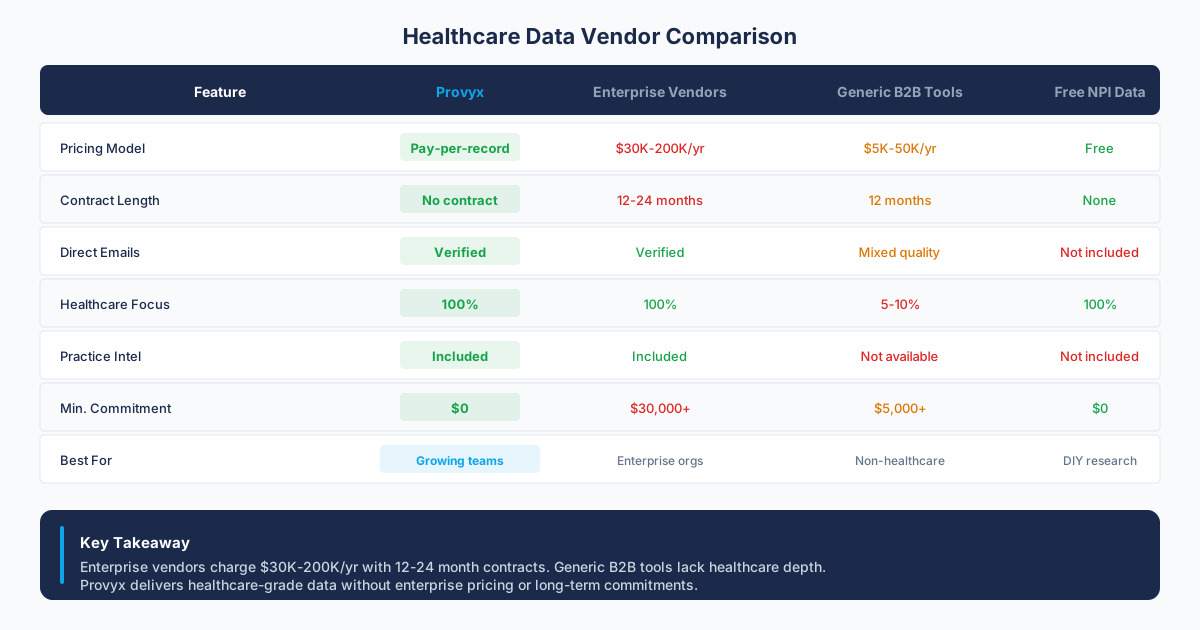
Provyx publishes this guide and offers the scoped research service discussed here. Evaluate suppliers on field evidence, entity resolution, delivery format, correction rules, and current commercial terms.
| Vendor category | Examples | Strength | Where they fall short |
|---|---|---|---|
| Healthcare commercial intelligence platforms | Definitive Healthcare, IQVIA | Deep hospital and health-system profiles, claims-informed analytics, affiliation mapping | Confirm current modules, seats, contract terms, and price directly |
| General B2B data platforms | ZoomInfo, Apollo, Data Axle | Broad company coverage, CRM integrations, self-serve access | Test specialty, provider-count, ownership, and EHR coverage on your target accounts |
| Healthcare-specific list builders | Provyx | Practice-level records built per project from NPI, business, and web data, priced per list with no subscription | Scoped to outpatient provider markets rather than full hospital analytics |
The right category follows from your target market. Teams selling into hospitals and health systems need affiliation trees and procurement context, which is the commercial intelligence platforms' home turf. Teams selling into private practices, the fragmented market of independent and small-group offices, need the practice-level fields this guide covers: provider count, ownership, specialty mix, and technology stack. General B2B platforms sit in the middle and work best when healthcare is one vertical among several you sell into.
As checked October 29, 2026, Provyx pricing has a $2,500 minimum, invoiced after delivery approval. Confirm the fields, available count, and schedule in the written scope. Compare that project with the current contract terms of any platform you are considering. The practice firmographics service describes the research scope.
Frequently Asked Questions
What is the difference between healthcare provider data and healthcare firmographic data?
Provider data describes individual healthcare providers: their name, NPI, specialty, credentials, and contact information. Firmographic data describes the practice or organization as a business entity: practice size (provider count), ownership structure, specialty mix, technology stack, number of locations, and estimated revenue. Provider data tells you who works at a practice. Firmographic data tells you what kind of business the practice is. You typically need both for effective B2B healthcare targeting: firmographics for account selection and prioritization, provider data for identifying the right contacts within those accounts.
How can I determine the technology stack of a medical practice?
Technology detection for medical practices uses several methods. Practice websites sometimes mention their EHR or patient portal vendor. Job postings for the practice may list needed experience with specific systems. Vendor directories and case studies occasionally name their customers. Some healthcare data vendors maintain technology detection databases built from these signals plus proprietary research. For individual high-value accounts, directly asking during a discovery call is reliable. At scale, purchasing technology detection data from a healthcare-specific vendor is the most practical approach.
How often do healthcare practice firmographics change?
It depends on the specific attribute. Provider count changes frequently as practices hire, lose providers, or bring on locum tenens staff. Technology stack changes occur less frequently but are significant when they happen, such as an EHR migration. Ownership changes are relatively rare for individual practices but affect entire portfolios when a DSO or health system makes an acquisition. Geographic location is the most stable attribute. Plan to refresh provider counts and technology data quarterly, ownership data semi-annually, and location data annually at minimum.
How should a firmographic field be accepted?
Define the entity level, source, observation date, and allowed values before testing. Ownership, size, location count, and system affiliation should each have an independent review rule.
Why keep provider and organization records separate?
A clinician can move while the practice remains, and an organization can change ownership while its location stays open. Separate entities and dated relationships keep those changes from creating false duplicates.
Sources and References
- CMS NPI Registry
- industry-standard Healthcare Provider classification
Related Resources
Get the Provider Data You Need
Tell us what you're looking for. We'll build a custom list matched to your target market.
Trusted by healthcare sales teams, medical device companies, and health IT vendors across the US.