
Telehealth Provider Data: Challenges and Solutions
Telehealth providers don't fit neatly into traditional healthcare databases. Their addresses are PO boxes, their licenses span 12 states, and half of them don't show up in the NPI registry the way you'd expect.
2026-04-02
The Telehealth Data Problem Nobody Talks About
Telehealth isn't new anymore. Post-pandemic use has stabilized at roughly 5-6% of all outpatient visits, according to the U.S. Department of Health and Human Services. That might sound small, but it translates to tens of millions of visits per year and thousands of providers who deliver care primarily or exclusively through virtual channels.
Here's the problem: traditional healthcare provider databases were built for brick-and-mortar practices. They organize data around physical addresses, local phone numbers, and single-state license records. Telehealth providers break every one of those assumptions. A telepsychiatry company might have providers licensed in 30 states, operating from home offices in 3 states, with a corporate address in a 4th state. Which address goes in your CRM? Which state do you assign to the territory rep?
If you're selling SaaS, devices, or services to telehealth providers, you need data that accounts for how these businesses operate in practice. This guide covers the specific challenges and practical solutions.
Virtual-Only vs. Hybrid: The First Segmentation That Matters
Not all telehealth providers are the same. The market splits into three distinct segments, each with different buying behaviors and data needs.
Virtual-Only Providers
These are companies and individual practitioners who deliver care exclusively through video, phone, or asynchronous messaging. Companies like Cerebral, Done, Talkiatry, and hundreds of smaller operations fall here. Individual providers who went fully virtual during the pandemic and never returned to in-person practice are also in this bucket.
Data challenges with virtual-only providers:
- No meaningful physical address.: Their NPI registration might list a home address, a UPS Store mailbox, or a registered agent's office. None of these are useful for territory mapping.
- Company vs. Individual NPI confusion.: Large telehealth companies often have an organizational NPI (Type 2) plus individual NPIs (Type 1) for each provider. If you're targeting the company, you want the Type 2 entity. If you're targeting individual prescribers, you want Type 1 records linked to that company.
- Rapid headcount changes.: Virtual-only companies scale provider headcount up and down quickly. A telehealth startup might go from 50 to 200 providers in a quarter, then back to 100 after a funding round falls through. Your data ages faster here than in any other healthcare segment.
Hybrid Providers
These are traditional brick-and-mortar practices that added telehealth as a service line. A primary care practice that sees patients in-office 3 days a week and offers telehealth visits 2 days. A behavioral health group that does initial assessments in-person and follow-ups via video. This is the largest segment by provider count.
The data challenge with hybrid providers is identifying which ones actively use telehealth vs. Which ones technically "offer" it but do fewer than 5 virtual visits per month. Many practices added telehealth capability during COVID, collected the FQHC or telehealth modifier reimbursements, and then quietly stopped once in-person volumes recovered. If you're selling telehealth-specific software, you need volume indicators, not just capability flags.
Telehealth Platforms
Companies like Teladoc, Amwell, MDLive, and their competitors operate as platforms that employ or contract with thousands of providers. These are enterprise sales targets, not individual provider outreach. Your data needs for this segment are completely different: company firmographics, decision-maker contacts (Chief Medical Officer, VP of Clinical Operations, Head of Provider Network), and contract details.
Check our mental health provider data guide for deep coverage of the behavioral health telehealth segment, which accounts for the largest share of virtual visits.
Multi-State Licensing: The Territory Planning Nightmare
A dermatologist in a brick-and-mortar practice in Chicago is licensed in Illinois. Simple. A teledermatologist based in Chicago might be licensed in Illinois, Indiana, Wisconsin, Michigan, Ohio, Iowa, and 6 other states. They see patients in all of them.
For sales teams, this creates a territory attribution problem. Which rep gets credit for this provider? The one covering Illinois (where the provider lives)? The one covering Ohio (where 30% of their patients are)? All of them?
The Federation of State Medical Boards (FSMB) tracks the Interstate Medical Licensure Compact, which now includes 40+ member states. This compact makes it easier for physicians to get licensed in multiple states, which means multi-state telehealth practice will keep growing. Your data and territory models need to account for this.
Practical Solutions for Multi-State Attribution
- Primary practice state.: Assign each provider to their primary state based on where they physically operate (home office or headquarters), regardless of how many states they're licensed in. This is the simplest approach and works for most sales motions.
- Patient volume weighting.: If you have claims data or patient volume estimates, attribute the provider to each state proportionally. A provider seeing 60% Illinois patients and 40% Indiana patients gets partial credit in both territories. More complex, but more accurate for market sizing.
- License state enumeration.: Store all license states in your database and make them searchable. When a rep needs to know "who's licensed to practice in Ohio via telehealth," they can query across the full license dataset, not just primary addresses.
DEA Telehealth Prescribing Rules: Why They Matter for Your Data
If you're selling to telehealth prescribers, the DEA's evolving telehealth prescribing rules are critical context. During the COVID public health emergency, the DEA allowed providers to prescribe controlled substances via telehealth without an in-person visit. As that flexibility winds down, the rules are getting more complex.
As of early 2026, the DEA has proposed rules that would require an initial in-person visit for Schedule II-V controlled substance prescriptions initiated via telehealth, with some exceptions. This directly affects:
- Telepsychiatry providers: prescribing stimulants (ADHD medications like Adderall, Vyvanse) and benzodiazepines
- Pain management telehealth: providers prescribing opioids and muscle relaxants
- Telehealth companies: built specifically around controlled substance prescribing (some of which have already shut down or pivoted)
For data purposes, you need to distinguish between telehealth prescribers who handle controlled substances and those who don't. A teledermatology company prescribing topical retinoids isn't affected by DEA rule changes. A telepsychiatry company prescribing Adderall is directly in the crosshairs. The DEA registration status and Schedule classifications in your provider data become critical filtering fields.
The Impact on Your Target List
DEA rule changes will cause market consolidation. Some virtual-only prescribers of controlled substances will need to add in-person capabilities or partner with brick-and-mortar practices. This means your data needs to track these transitions. A provider who was virtual-only in 2025 might be hybrid by mid-2026. If your database still shows them as virtual-only, your reps are working with outdated intelligence.
Selling SaaS to Telehealth Providers
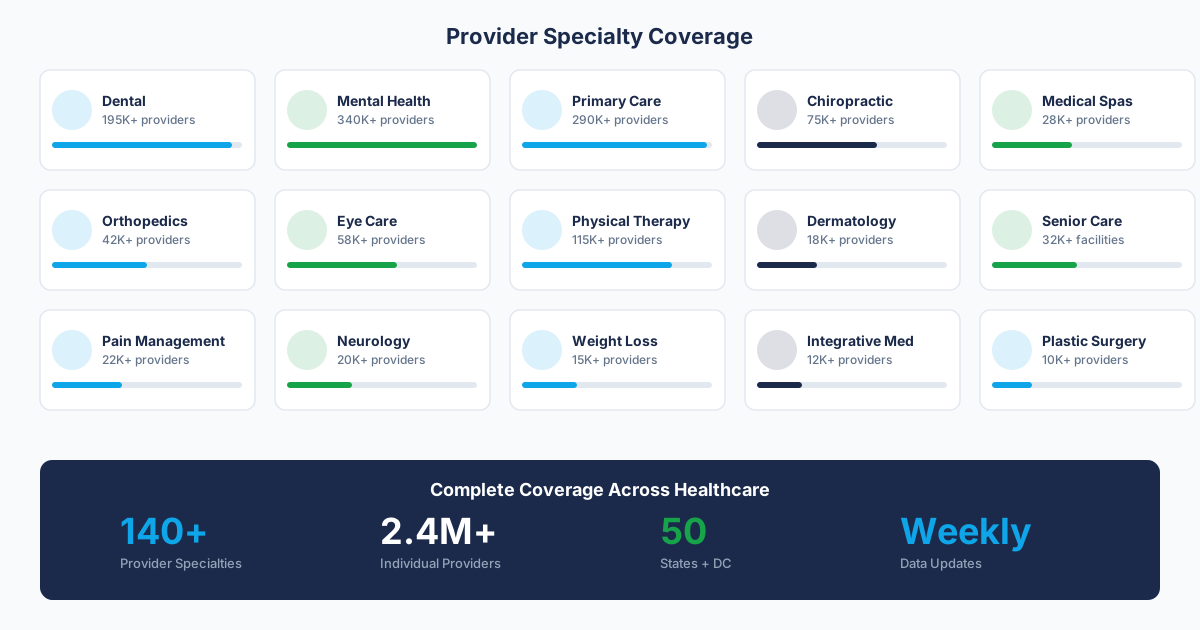
If you're selling practice management software, EHR systems, patient engagement tools, or other SaaS products to telehealth providers, here's what your data needs to include beyond standard practice fields.
Technology Stack Indicators
Telehealth providers are technology-native by definition. They already use video platforms, EHR systems, e-prescribing tools, and patient scheduling software. Your competitive landscape is denser here than in traditional practices where some providers are still using paper charts.
Key data points:
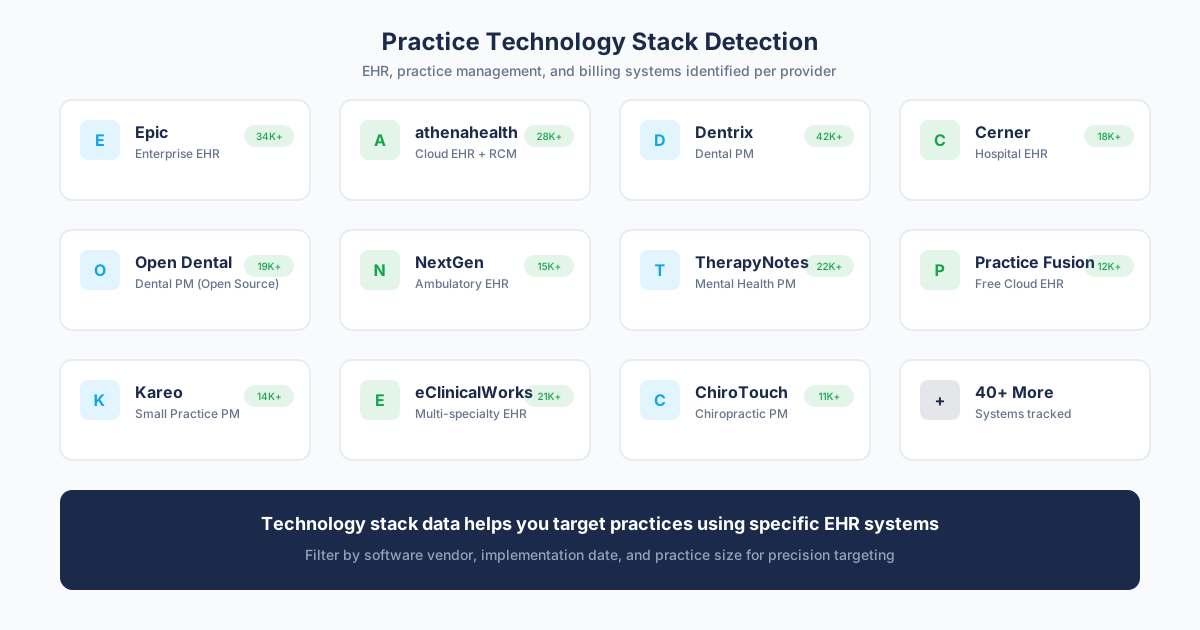
- Current EHR system.: Is the provider on a major platform (Epic, Cerner, athenahealth) or a telehealth-specific system (Wheel, Truepill infrastructure, custom build)?
- Video platform.: Doxy.me, Zoom for Healthcare, proprietary. This indicates how integrated their telehealth tech stack is.
- Practice size.: Solo telehealth providers buy differently than 50-provider telehealth companies. Solo providers want simplicity. Larger operations want API integrations and reporting.
- Funding status.: For venture-backed telehealth companies, funding stage affects buying capacity and urgency. A Series B company with fresh capital is a better SaaS prospect than one that just did layoffs.
Selling Devices to Telehealth Providers
This sounds counterintuitive, but telehealth providers are a growing market for medical devices, specifically remote patient monitoring (RPM) devices. Blood pressure cuffs, continuous glucose monitors, pulse oximeters, and other home-use devices are prescribed or recommended by telehealth providers to compensate for the lack of in-person vital signs collection.
RPM is one of the fastest-growing telehealth reimbursement categories. Providers can bill CPT codes 99453, 99454, 99457, and 99458 for RPM setup, data transmission, and monitoring. This creates a financial incentive for telehealth providers to incorporate devices into their practice.
Data needs for RPM device sales: provider specialty (chronic disease management specialties like endocrinology, cardiology, and pulmonology are highest-value targets), patient panel size (more patients = more device volume), current RPM program status (already billing RPM codes vs. Not yet), and payer mix (Medicare patients drive RPM reimbursement).
Finding Telehealth Providers in Your Data
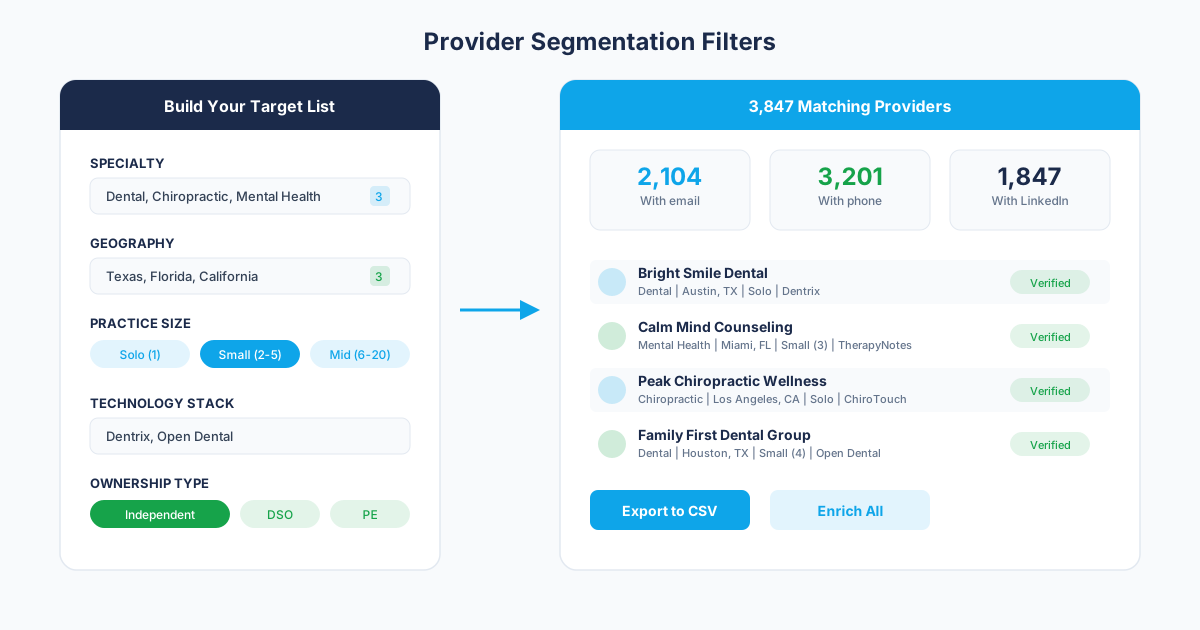
Here's the step-by-step process for building a telehealth provider database.
Step 1: NPI Registry Signals
The NPI registry doesn't have a "telehealth" flag. But there are signals. Look for: practice addresses that are clearly residential or virtual office spaces, providers with multiple practice location addresses in different states, and specialty classifications associated with high telehealth adoption (psychiatry, psychology, primary care, dermatology).
Step 2: State License Cross-Referencing
Providers with licenses in 5+ states who aren't part of a large health system are likely doing telehealth. Cross-reference NPI data with state medical board records to build a multi-state license profile for each provider. The Interstate Medical Licensure Compact database is a useful starting point.
Step 3: Telehealth Platform Identification
Identify providers affiliated with known telehealth platforms. Scrape organizational NPI records for major telehealth companies, then link individual providers to those organizations. This captures employed and contracted telehealth providers who might not be identifiable from NPI data alone.
Step 4: Website and Marketing Signal Analysis
Practices that offer telehealth almost always market it on their websites. Look for: "telehealth," "virtual visits," "online appointments," video platform integration pages, and state-specific "we see patients in..." language. This is particularly useful for identifying hybrid providers who added telehealth as a service line.
Step 5: Claims-Based Identification
If you have access to claims data, telehealth visits are identifiable through place-of-service code 02 (Telehealth Provided Other than in Patient's Home) and modifier 95 (Synchronous Telemedicine Service). Providers with significant volume on these codes are confirmed telehealth practitioners.
Data Quality Challenges Specific to Telehealth
Beyond the structural challenges already discussed, telehealth data has unique quality issues that affect every downstream use case.
Address Instability
Virtual-only providers change addresses more frequently than brick-and-mortar practices because their address is often a home office or virtual mailbox. When a provider moves from Austin to Denver, their practice "moves" too. In traditional healthcare data, an address change might happen once per decade. For virtual providers, it can happen yearly. This means your data refresh cadence needs to be more aggressive for telehealth segments.
Provider-Company Attribution
Many telehealth providers work for multiple platforms simultaneously. A psychiatrist might see patients through Talkiatry 3 days per week and through their own independent practice 2 days per week. Your data might show them affiliated with Talkiatry, with their independent practice, or both. Getting this attribution right matters for targeting: if you're selling to the platform, you need to know which providers are on it. If you're selling to independent providers, you need to exclude platform-employed ones.
Credential Verification Complexity
Telehealth providers practicing across state lines need active licenses in each state. License lapses are more common in multi-state scenarios because providers have more renewals to track. A provider licensed in 12 states who lets 3 licenses lapse is still active in 9 states. Your data should reflect current license status by state, not just a single "active/inactive" flag. Review our mental health provider data for examples of multi-state license tracking in the highest-telehealth-adoption specialty.
Telehealth Market Sizing: Getting the Numbers Right
Market sizing for telehealth is tricky because the definition keeps shifting. Here's a framework that works:
- Virtual-only companies and their employed/contracted providers.: Start with the known telehealth companies and count their provider networks. This is the most clearly defined segment. Estimated at 50,000-80,000 providers nationally, though many work part-time on these platforms.
- Hybrid practices with active telehealth service lines.: Estimated at 150,000-200,000 practices that conducted at least 10 telehealth visits in the past quarter. This number is softer because it depends on how you define "active."
- Individual providers with telehealth capability but low volume.: Hundreds of thousands of providers technically have telehealth capabilities through their EHR system. Most don't use it regularly. Including them inflates your TAM without improving your pipeline.
For most sales motions, segments 1 and 2 are your real TAM. Segment 3 is aspirational. Your data should clearly distinguish between them so you can focus outreach on providers who are doing telehealth, not providers who once set up a Zoom account. Check out our 2026 provider data trends article for broader context on how verification frequency affects data quality across all segments.
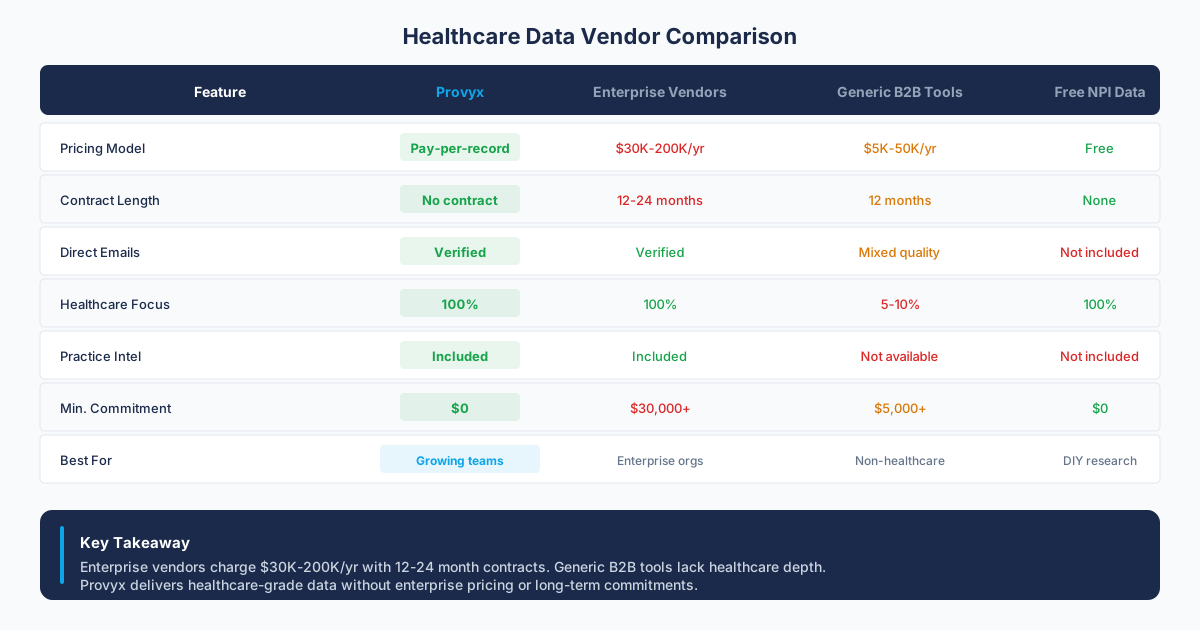
What to Ask a Data Vendor About Telehealth Coverage
Before buying telehealth provider data from any source, ask these questions:
- How do you identify telehealth providers vs. Traditional in-person practices?
- Can you distinguish virtual-only providers from hybrid practices?
- Do you track multi-state licensure at the provider level?
- How do you handle address data for virtual-only providers?
- Do you track telehealth platform affiliations (which providers work for which platforms)?
- How frequently is your telehealth data refreshed? (This should be more frequent than traditional provider data)
- Can you provide technology stack data (EHR, video platform, RPM capabilities)?
- Do you track DEA registration and controlled substance prescribing authorization?
If the vendor's telehealth coverage is just "NPI records with a telehealth tag," that's not sufficient. The telehealth segment requires purpose-built data enrichment that goes well beyond standard provider databases.
Need telehealth provider data that reflects how virtual care works? Contact Provyx to discuss your specific use case and see sample records.
Frequently Asked Questions
How do I identify telehealth providers in healthcare databases?
There's no single 'telehealth' flag in the NPI registry. You need to combine multiple signals: multi-state licensure patterns, practice addresses (virtual offices, residential), telehealth platform affiliations, website marketing language mentioning virtual visits, and claims data with place-of-service code 02 or modifier 95. Purpose-built telehealth datasets layer these signals to classify providers as virtual-only, hybrid, or telehealth-capable but inactive.
What's the difference between virtual-only and hybrid telehealth providers?
Virtual-only providers deliver care exclusively through video, phone, or asynchronous messaging with no physical clinic. Hybrid providers operate traditional brick-and-mortar practices that also offer telehealth as a service line. Hybrid is the larger segment by provider count. The distinction matters because their technology needs, buying processes, and data profiles are very different.
How do DEA telehealth prescribing rules affect provider data?
The DEA's evolving rules around controlled substance prescribing via telehealth directly impact providers in psychiatry, pain management, and ADHD treatment. Proposed rules may require initial in-person visits for controlled substance prescriptions started via telehealth. This will force some virtual-only prescribers to add in-person capabilities or shut down, changing their data profile from virtual-only to hybrid or inactive.
How should I handle territory assignment for multi-state telehealth providers?
Three common approaches: (1) assign to the provider's physical home base state, (2) weight assignment by patient volume across states, or (3) store all license states and allow multi-territory querying. Most sales teams use option 1 for simplicity but maintain searchable license data for market sizing and coverage analysis.
Can I use NPI data alone to build a telehealth provider list?
NPI data alone is insufficient for telehealth targeting. It lacks telehealth activity indicators, multi-state license details beyond the registration address, platform affiliations, technology stack information, and virtual vs. Hybrid classification. You need enrichment from state medical board records, website analysis, platform employment data, and ideally claims-based telehealth use signals.
What types of products sell well to telehealth providers?
The main categories are: SaaS (practice management, EHR, patient engagement, scheduling), remote patient monitoring devices (blood pressure cuffs, glucose monitors, pulse oximeters), e-prescribing and pharmacy integration tools, clinical decision support software, and patient communication platforms. RPM devices are a particularly fast-growing segment due to dedicated Medicare reimbursement codes.
Sources and References
Related Resources
Get the Provider Data You Need
Tell us what you're looking for. We'll build a custom list matched to your target market.
Trusted by healthcare sales teams, medical device companies, and health IT vendors across the US.